Original George V Royal Navy Long Service and Good Conduct Medal EDMUND ARTHUR PIDGEON RN
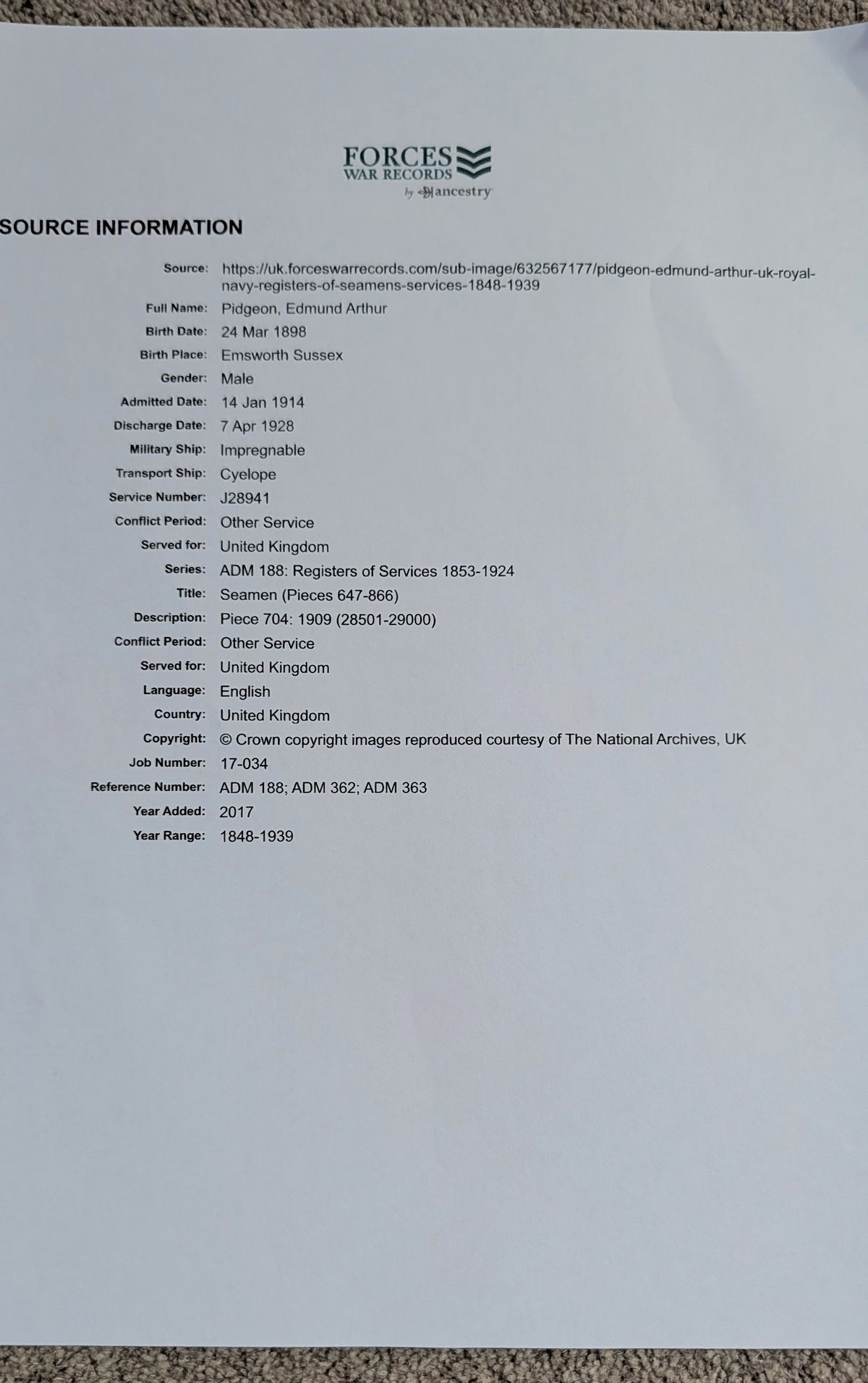
Awarded in 1931 to E A Pigeon (J28941)
He was born on 24th March 1898 in Emsworth in West Sussex and
He began his service with a rank of 'Boy' at the age of 15 on 14th Jan 1914.
He was discharged on the 7th April 1928 After just over 14 years of service. He reached the rank of Able Seaman.
A copy of his Service history is included but it can be summarised as :
- as WW1 started he was at the training ship HMS Impregnable in Plymouth.
- his first WW1 deployment was in 1916 aboard HMS Hilary, an armed merchant cruiser.
- after a number of shore base postings he was aboard Depot ship HMS Hecla in Sept 1917
- ln Oct 1917 he moved to serve on the armoured cruiser HMS Blenheim.
- after the war he served on the cruisers HMS Dido and HMS Conquest as well as a number of Portsmouth based shore establishments.
His entitlement to the medal which has a 15 year qualification period is quite complex
His Reckonable Service Only Started at 18 as any time served as a "Boy" (under 18) did not count toward the 15 years required for the Naval Long Service and Good Conduct Medal.
Counting 15 years forward from his 18th birthday in 1917 brings his official qualification date to 1932.
He was discharged in 1928, as when a boy signed up, they typically committed to a 12-year continuous service engagement that only began ticking on their 18th birthday.
As he was discharged slightly early in 1928, it means he finished almost his entire 12-year adult contract but fell just short of the 15 years needed for the medal while on active service.
However, he likely qualified by counting his subsequent time in the Royal Fleet Reserve (RFR). When sailors finished their active contracts, they were routinely transferred to the reserves to complete their remaining service obligations. Once his combined active and reserve service hit the 15-year mark (around 1932), the admiralty back-dated, processed, and struck the medal, sending it out to him during the major administrative roll-out of late 1931/1932.