WW1 Royal Marines Light Infantry Medal Quartet & Service & Masonic Papers - George Thomas Norman who was involved in the Murmansk Campaign in Russia in 1918
The medal set contains :
- WW1 1914-15 Star
- WW1 Victory Medal
- WW1 War Medal
- George V Navy Long Service & Good Conduct medal (awarded 25th March 1925)
The set also contains his original service history document which is a fascinating record, together with a Real photo postcard featuring him at the centre
Also included is a small flag which is likely to be a souvenir from part of his Service.
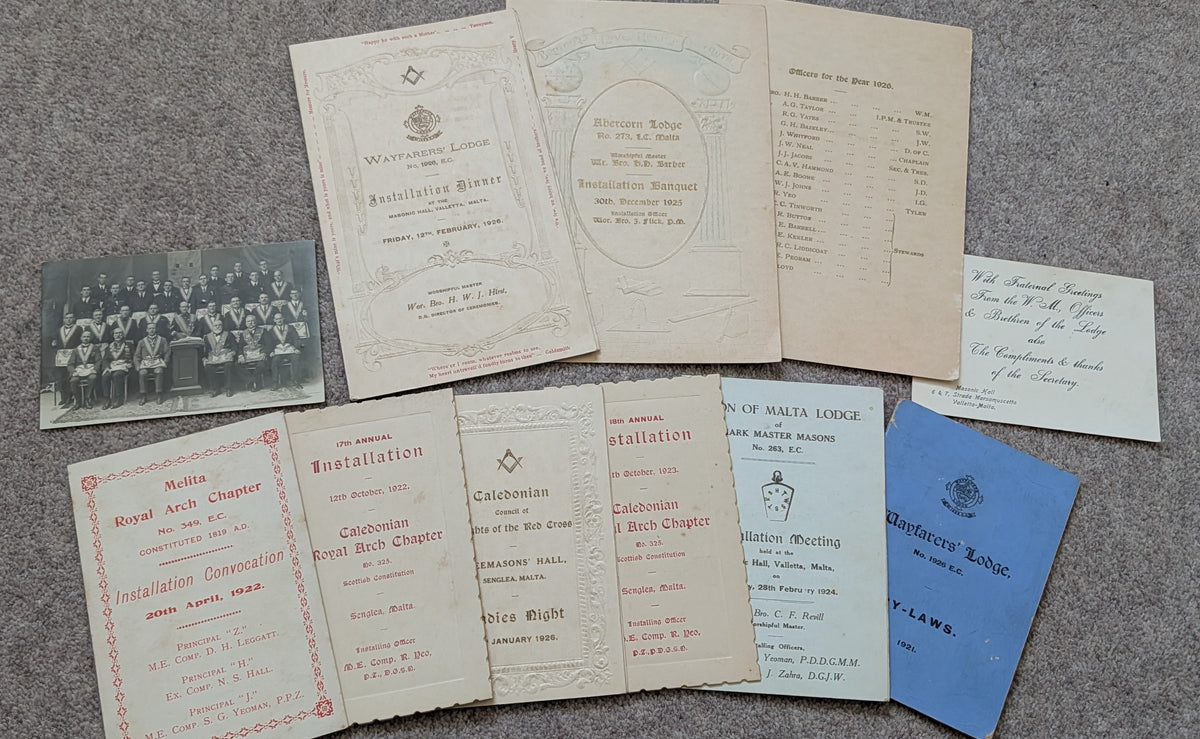
It also contains his Masonic certificates for :
- Sir Redvers Buller Lodge 1921
- Union of Malta Lodge 1922
- Noah Lodge Malta 1922
- Melita Chapter Malta 1923
- Wayfarer Lodge Malta 1926
+ A number of Masonic booklets
Note that during the early 1920s he was based at the HMS Egmont fort / shore base in Malta, providing the connection to Malta - the Real photo Postcard shows him in his RM uniform in a Masonic setting.
There are also copies of a number of items of research material including a nice pictorial summary
George Thomas Norman R.M.L.I. (15674)
George was born in 1891 in Braintree in Essex England.
He enlisted in the Royal Marines on 2 June 1910 as a Recruit at the Deal Depot in Kent.
Portsmouth Division: After training, he was assigned to the Portsmouth Division in May 1911.
He spent his early career on the cruiser HMS Essex (1912) and the cruiser HMS Royal Arthur (1912–1913).
He served aboard HMS Spartiate from 15 February 1913 to 30 June 1913. During this pre-war era, HMS Spartiate was a training ship that frequently interacted with Atlantic transit routes. Furthermore, his early cruiser deployments routinely patrolled the Atlantic and West Indies stations.
His WW1 service included both the Mediterranean to the Arctic Circle:
HMS Prince of Wales: He boarded her in Feb 1915 and remained until April 1917. This long deployment in the Mediterranean and Adriatic is what earned him his 1914–15 Star.
HMS Glory (The Murmansk Campaign): his Service document tracks his time on the Arctic flagship. He served on HMS Glory from 22 Feb 1918 to 17 Oct 1918.
On 6th March 1918—just two weeks after he arrived on board, HMS Glory landed a party of 130 Royal Marines directly onto Russian soil to secure Murmansk and hold off a feared invasion by Finnish forces aligned with Germany.
In May 1918, the Admiralty formed the Royal Marine Field Force North Russia. This field force pulled together a dedicated company of RMLI troops comprised of a platoon from each of the major divisions. As a Corporal, Norman would have been leading one of these specialized infantry squads.
-
HMS Glory (On Passage): From 18 October 1918 to 28 October 1918, he is listed as "On Passage"—meaning he was aboard a transport vessel heading back to the UK right before the Armistice.
Following the war he chose to remain a career Marine, leading to his eventual Long Service decoration:
-
HMS Minotaur: Directly after returning from Russia, he joined the armored cruiser HMS Minotaur (December 1918 – December 1919).
- He was Promoted to Sergeant in April 1919.
-
Shore Battalions: In 1920, he served with the 6th Royal Marine Battalion (6th R.M. Bn) at Chatham.
-
HMS Centurion & HMS Egmont: In the early 1920s, he served aboard the battleship HMS Centurion and the shore base HMS Egmont (Malta).
- George then returned home to live in Portsmouth but unfortunately in August 1928 he was seen drunk during the day whilst wearing his uniform. A copy of the newspaper report details that he was due to be demoted as a result. Before a demotion took place George tragically took his own life on the 18th August 1928.